
Arrest Warrants in Nelson County
Virginia Code § 19.2-72 lets an authorized judicial officer issue an arrest warrant after examining a complainant or witness under oath and finding probable cause. Written complaints are required in two situations. A felony complaint must be in writing. So must a complaint from someone outside law enforcement. The warrant directs an arrest and is returnable to the court with jurisdiction over the charge. In Nelson County, that probable-cause review usually runs through the magistrate system, and the case later lands in whichever court fits its type and stage. A new arrest warrant is not a capias after indictment. Nor is it the bench-type process that follows a missed court date. Before acting in Nelson County, confirm the record label, the charge, and the return court with the issuing clerk.
How Nelson County Arrest Warrant Review Starts
Probable-cause review begins when an officer, a prosecutor, or a private complainant presents facts to an authorized officer. The magistrate examines witnesses under oath. A private felony complaint needs prior approval. That signoff must come from the Commonwealth's Attorney or a law-enforcement agency with jurisdiction, and the magistrate or judge then decides whether process is supported. Initial bail may be set at that stage. Nelson County belongs to Judicial District 24. Its magistrate contact is a regional office in Lynchburg rather than a guaranteed county walk-in desk, so ask the Sheriff or the clerk which court holds the file. The complaint and probable-cause rule governing each of these steps sits in Virginia Code § 19.2-72.
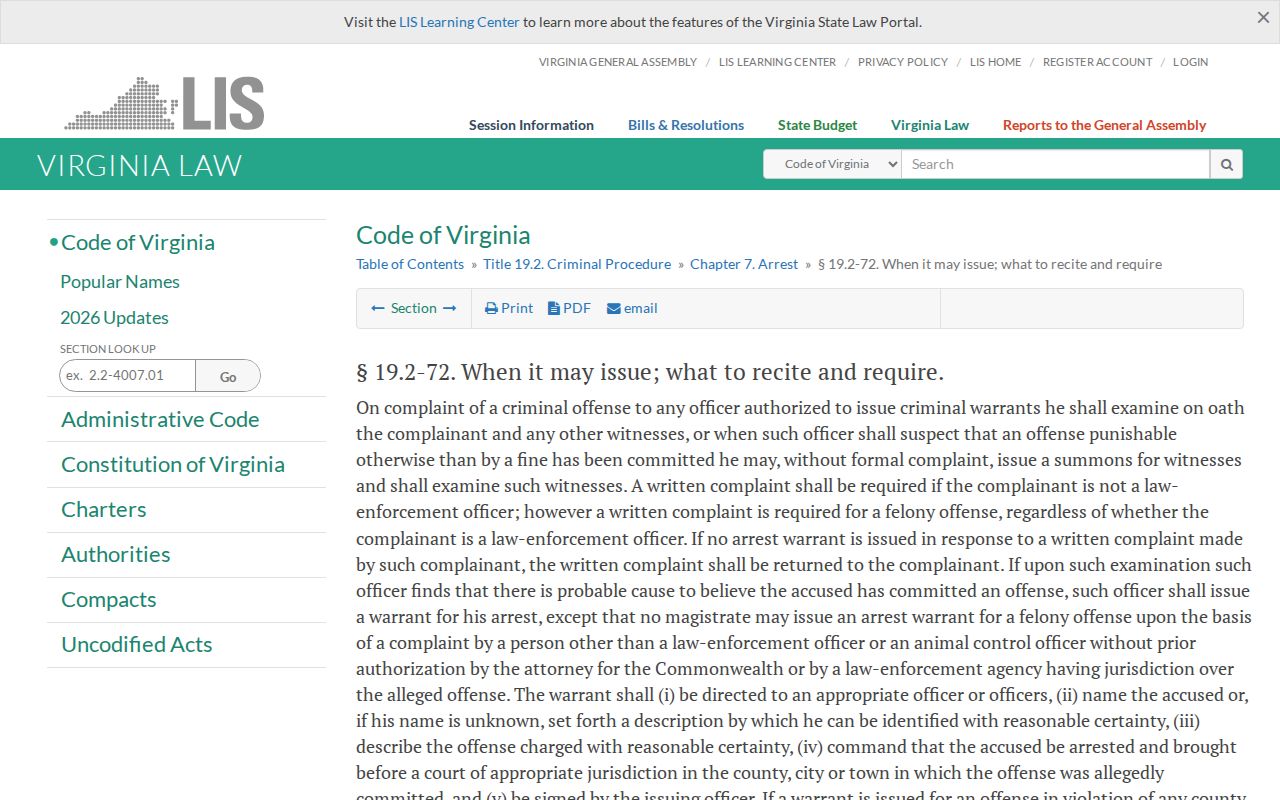
This state rule does not publish Nelson case or warrant records.
What a Nelson County Arrest Warrant Contains
Nelson County posts no sample warrant entry. So treat these fields as an outline only. The clerk or Sheriff may hold a case number, charge, issuing officer, dates, bond terms, serving agency, and execution return. Identifiers and investigative details can be redacted. Nelson County's public case tools do not expose a warrant-specific search result with every field, so ask the clerk what the actual record shows.
| Case / cause number | Links the process to the court file; use the exact value from a notice. |
|---|---|
| Charge and class | Offense and felony or misdemeanor status, if disclosed. |
| Issuing authority | Magistrate or judge; the return court handles the case. |
| Issue and return dates | Dates for process and required appearance; service can occur later. |
| Bond and status | Case-specific terms and service/recall information to confirm with the clerk. |
Private Felony Complaints Require Approval
Virginia law adds a safeguard for private felony complaints. A magistrate cannot issue that warrant on a private complaint alone. Approval must come first. It can come from the Commonwealth's Attorney or from a law-enforcement agency with jurisdiction. Writing is required as well. A felony complaint must be in writing, and so must one from outside law enforcement. It differs from a capias after indictment. For a Nelson County case, ask the clerk whether the process began as a probable-cause complaint, an indictment, or a missed appearance. Those paths use different case numbers. They may return to different courts, and the label alone does not say which. The official Virginia magistrate information page explains the magistrate's role and the regional system serving Nelson County.
How Nelson County Arrest Warrants Are Served
The Nelson County Sheriff's Office leads law enforcement here. It reports serving criminal warrants, securing courts, and handling civil process. Virginia law permits authorized officers to execute a warrant or capias issued elsewhere in the Commonwealth. A service return shows what happened next. It is not the judge's ruling on the charge. The Sheriff's 2024 report lists 1,315 criminal warrants served that year. That is a completed-service count. It is not an outstanding inventory. It is not a count of arrest warrants alone. The same report names state and regional task-force partners for investigations, not a public self-check service. For the execution and return rule, see Virginia Code § 19.2-76. Ask the Nelson County Sheriff whether its records show a service attempt or return for a specific case.
Nelson County Warrant Service Has Stages
After an arrest, the officer brings the person before a judicial officer without unnecessary delay. A magistrate sets initial bail. The return court carries the case forward from there. Depending on release conditions, a person may go home or be booked at Albemarle-Charlottesville Regional Jail, which serves Nelson County but cannot recall a warrant or set the next court date.
Nelson County Sheriff
434-263-7050
Service and law-enforcement records.
Regional Jail
434-977-6981
Custody and booking questions after arrest.
Call the clerk for docket details. Call the jail for custody status. ACRJ says courts schedule video hearings, though not every Nelson County hearing is promised by video, and the ACRJ accreditation page lists the jail's records contact route.
Jail records never replace confirmation from the issuing court on a warrant; the Albemarle-Charlottesville Regional Jail homepage identifies the facility serving Nelson County.
Use the issuing court, not the jail homepage, to confirm warrant status.
Arrest Warrant vs Summons vs Bench Warrant
These labels mark different legal steps. An arrest warrant authorizes taking a person into custody after probable-cause review. A summons only orders an appearance. A bench-type warrant or capias may follow a missed appearance, contempt, or later court process, and while the Nelson County Sheriff may serve each one, the clerk and judge control the court record and the next setting.
| Process | Why it may issue | Who to ask |
|---|---|---|
| Arrest warrant | Probable cause for an offense | Magistrate / return court |
| Summons | Order to appear in court | Issuing clerk |
| Bench warrant / capias | Missed date, indictment, or court order | Court that issued process |
Ask the Nelson County clerk to name the process and its return court rather than trusting a shorthand description.
Before a Nelson County Warrant Surrender
Slow down before acting on a serious Nelson County arrest warrant. First, call the issuing clerk. Talk to a Virginia lawyer too. Find out whether the court permits a scheduled appearance, a motion, a walk-through, or a voluntary surrender. Ask if bail is set, and which office takes you if the court directs a surrender. Nelson County publishes no warrant-counter hours, no surrender window, and no county bond schedule, so do not assume the Sheriff's front office can take a bond or recall a warrant.
Confirm first: Ask the clerk or counsel for the proper location, current bond terms, and return date before appearing.
If the court orders bond, confirm the amount and the accepted payment method with the court or jail. Save every receipt and written order. After release, ask when the next appearance is and confirm the process status changed. Posting bond does not dismiss the charge, and service does not end the case. Nelson County's warrant-resolution overview shows how the Circuit Court, GDC, Sheriff, and regional jail divide these steps.
What the Nelson County Arrest Record Shows
A public case entry can mislead. It may show a hearing or process event while leaving out sealed material, service details, or current bond status. The state's case search covers only participating courts and categories. Circuit information is not in one statewide system, and JDR access is restricted. No result? Call the Nelson County Circuit Clerk at 434-263-7020 or General District Court at 434-263-7040, depending on the case. Other offices hold other pieces. The Sheriff may have an execution or return record, and ACRJ may have a booking or custody record, so ask each office only for the record it keeps. A FOIA request can seek an existing agency document, though it cannot force release of a protected, investigative, or unserved record. The Sheriff's official page lists public contacts and the route for requesting Nelson County records.
What to Do If There's a Warrant for You
Start with paper and a phone. Write down the court, the case number, the charge, and any return date. Then call the clerk and ask what the docket says. Ask whether a judge set bail and whether counsel or a motion is needed. In Nelson County, felony cases and indictment capias records go to Circuit Court, while adult traffic and misdemeanor cases go to GDC, and JDR handles family and juvenile records through its restricted channel. Ask the Sheriff about service status if that matters. If someone is already booked, call ACRJ for custody details and the return court for the next hearing. Keep proof of payment, bond, recall, or appearance, and call again if the public system lags. Plan the next step on the clerk's answer, not a third-party result.